
Suffering - The Book of Joy
Jul 14, 2026
When Mom first started talking to us boys about the Dalai Lama, I was pretty sure she was talking about some kind of animal. It sounded a lot like “llama” so there must’ve been a connection.
It took me many years later to see the Dalai Lama as a source of strength for me during times of suffering.
Everyone suffers
I’ve been thinking about suffering a lot lately. Probably because of the many conversations I have with people; and because of my own suffering.
Suffering is universal. Every human being suffers. We don’t get to opt out. To be alive is to suffer.
Once we accept that suffering is normal, life becomes easier.
Suffering spreads to loved ones
This week has been difficult.
My dear friend Ang has been in the hospital for the past six days. She had just completed her third week of a four-week 200-hour Yoga Teacher Training course in Chiang Mai.
She has been diagnosed with myocarditis, an inflammation of the heart muscle. Her doctors are trying to understand the underlying cause of her elevated troponin levels – a marker that indicates injury to the heart muscle.
She is suffering physically. I am suffering emotionally.
This experience has reminded me that suffering is rarely confined to one person. It ripples outward to those who love and care for us. Watching someone you love suffer has a way of dissolving the illusion that we’re separate from one another.
The Book of Joy
For my birthday this year, Ang sent me a book by the two giant spiritual leaders, His Holiness the Dalai Lama and the late Archbishop Desmond Tutu.
The book was written with Douglas Adams who captured the week the two spiritual masters spent together in April 2015 when Archbishop Tutu traveled to the Dalai Lama’s home in exile in Dharamsala, India. Well done, Mr. Adams, thank you.
The Book of Joy: Lasting Happiness in a Changing World:
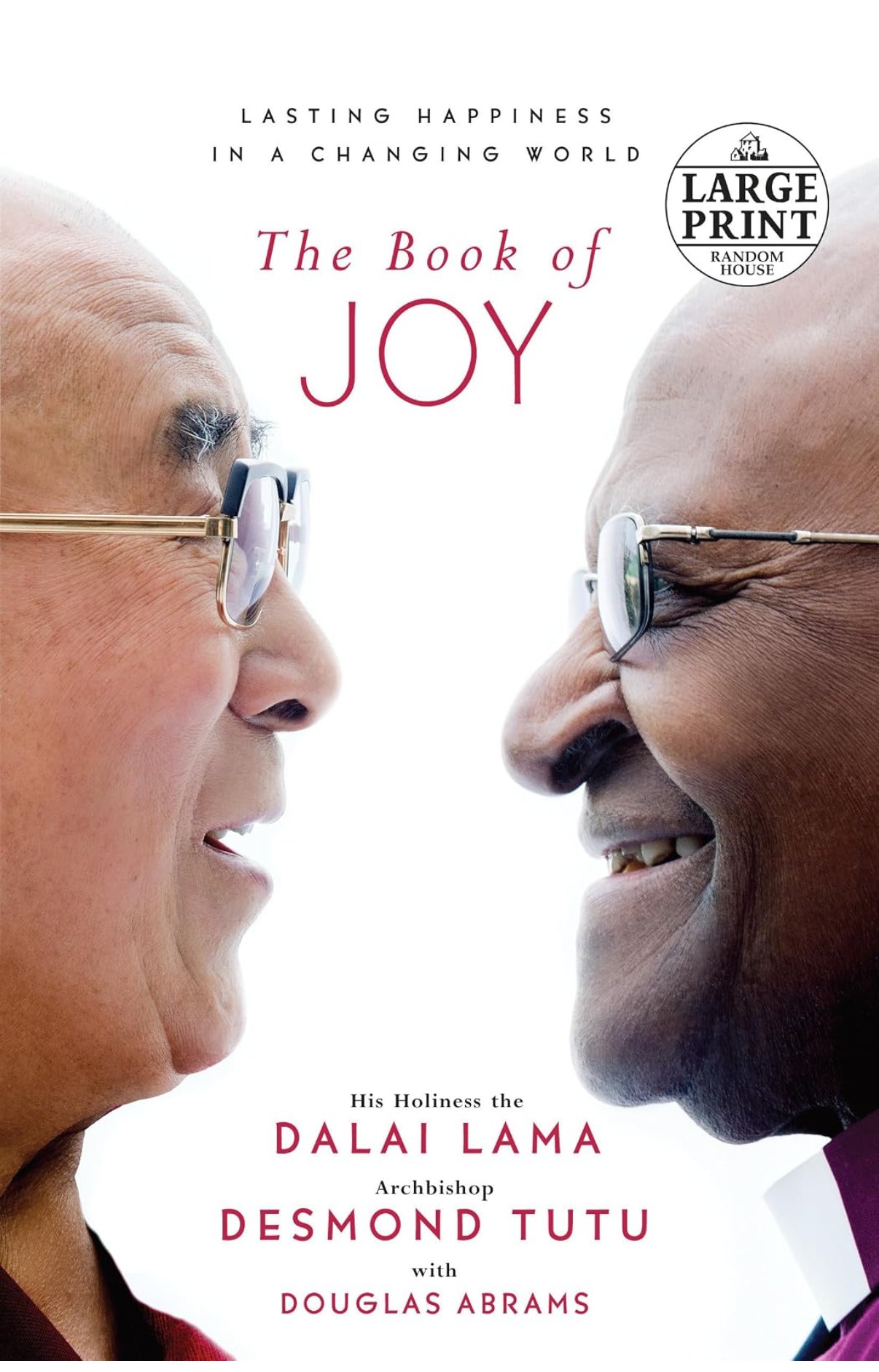
When Ang was hospitalized this week, I turned to this book for wisdom.
Here are some of the themes that resonate with me:
Freedom to choose our response
We cannot always choose our circumstances.
Illness. Aging. Loss. Betrayal. Disappointment. Death.
However, we can control our response to suffering.
The Buddha's famous metaphor about two arrows is this: the first arrow is unavoidable pain. The second arrow is all the mental stories we create afterward.
I believe most of our suffering we create ourselves, in our own minds. Suffering is inevitable. How we respond is our choice. No one can take away our freedom to choose our response.
“Everything can be taken from a man but one thing: the last of the human freedoms—to choose one’s attitude in any given set of circumstances, to choose one’s own way.” - Viktor E. Frankl, Man's Search for Meaning.
Joy
We become happier when happiness stops being the goal.
Joy isn't something we chase. It’s a by-product of living with compassion, gratitude, humility, forgiveness, and service.
When we're obsessed with our own happiness, we often become less happy.
When we're absorbed in helping others, joy quietly arrives.
Joy is not the absence of suffering. It’s the capacity to keep loving life despite suffering. Gratitude. Friendship. Humor. Purpose. Nature. Spiritual practice.
These don't erase pain. They increase our resilience.
“As we discover more joy, we can face suffering in a way that ennobles rather than embitters. We have hardship without becoming hard. We have heartbreak without being broken.”
“The ultimate source of happiness is within us. Not money, not power, not status. Some of my friends are billionaires, but they are very unhappy people. Power and money fail to bring inner peace. Outward attainment will not bring real inner joyfulness. We must look inside.”
Compassion
When we see others suffer, we gain compassion.
Suffering is an essential element for developing compassion.
When we realize every person we meet is carrying invisible burdens – the decorated lawyer, the elderly waiter, the clerk at the department store counter, the exhausted high school coach, the divorced dad – our hearts soften. That is the essence of compassion.
When we are ready, compassion replaces comparison, connection replaces isolation. Concern for others’ well-being is a source of happiness.
Self-absorption magnifies suffering
The dharma teachings emphasize lessening one’s self-absorption.
When we focus only on ourselves, we are destined to be unhappy.
Our minds constantly ask, What about me? What do people think of me? Why me? How do I feel? What’s in it for me? What do I have to lose?
The more attention turns inward, the larger suffering appears. Excessive self-concern narrows our world.
We need to loosen the grip of self-absorption – our attachment to the idea that "I" am the center of everything.
Less self-absorption brings more compassion, less suffering, less grasping, less clinging, less ego, and more compassion, more equanimity, more presence.
Concern for others expands the heart
When our attention shifts toward helping others – listening, encouraging, serving, being generous – our own problems don't disappear. They simply stop occupying the entire stage.
This is why volunteering, mentoring, friendship, and kindness consistently correlate with greater well-being.
When we notice the suffering around us, when we have a wider view beyond ourselves, our own worries and suffering will lessen.
It’s not denial of our pain and suffering, but a shift in our point of view. When we see others’ suffering, we realize we do not suffer alone. Our pain is lessened when we have compassion for others’ suffering.
Wisdom comes from suffering
Most people spend enormous energy trying to eliminate suffering. But most wisdom traditions say the opposite. Suffering isn’t the exception. It’s the price of being alive. Ironically, suffering often becomes our greatest teacher.
Most people don't become wiser because life is easy. They become wiser because something breaks them open – loss, illness, failure, divorce, aging, loneliness.
Those experiences force us to ask questions we would never have asked when life was comfortable. Wisdom is gained from the transformative potential inside of suffering.
Background on the Dalai Lama
The current Dalai Lama, Tenzin Gyatso, is the 14th to be chosen by senior Buddhist monks in Tibet. The title was first given in the 1500s by the Mongol ruler Altan Khan to the third Dalai Lama. The first two were recognized retrospectively after the title came into use.
The Dalai Lama is both the spiritual leader and political leader of Tibet.
“Dalai” is a Mongolian word meaning “ocean.”
“Lama” is a Tibetan word meaning “wise teacher.”
So “Dalai Lama” is often translated as “Ocean of Wisdom.”
Tenzin Gyatso was born in 1935, and as a small child, was recognized as the reincarnation of the 13th Dalai Lama who died in 1933.
After a Dalai Lama dies, senior monks begin a search that can take several years of identifying possible children after much consideration and testing.
In 1950, when China invaded Tibet, the current Dalai Lama was only 15 years old.
In 1959, he secretly escaped across the Himalayas to India where he continues to live in exile.
Conclusion
I always considered my mom a closet Santa Cruz – California hippie. In the 1960s, she used to take us boys to those head shops in Aptos, Capitola, and Santa Cruz where they sold incense, beads, psychedelic art, blacklight posters, tie-dye clothing, etc. My crew-cut conservative dad avoided those shops.
I think it was in one of those shops where she bought the large Buddha statue that lived in our backyard for decades and, in later years, followed her wherever my parents lived. I absolutely loved those shops, especially the smell of burning incense.
I learned compassion from my mom. She was a saint. She made everyone smile and never had anything negative to say about anyone. Without explicitly doing so, she taught me the practice of Loving Kindness.
To learn about Loving-Kindness Meditation, see Jon Kabat-Zinn’s book, Wherever You Go, There You Are: Mindfulness Meditation in Everyday Life.
Men often believe suffering is something to hide. We tell ourselves to "man up," keep moving, stay productive, never let anyone see us bleed emotionally. But hidden suffering tends to become shame, and shame becomes isolation.
Suffering is not evidence of weakness—it is evidence of humanity. The question is not whether we suffer, but whether we allow suffering to make us more bitter or more compassionate.
In The Book of Joy, The Dalai Lama and Desmond Tutu don't come across as joyful because they escaped suffering. They come across as joyful because suffering enlarged their hearts rather than closed them.
Perhaps the goal of life is not to avoid suffering. Perhaps it is to become the kind of person who can meet suffering with courage, respond with compassion, and continue to love life anyway.
Be well,
Peter
Related Links:
Losing Jenny - Buddhism's Four Noble Truths
The Courage to be Disliked - True Freedom
Sign up for my newsletter here
Author