
The Courage to be Disliked - True Freedom
Apr 05, 2026Ao Nang Beach, Krabi, Thailand
Outline
- The Courage to Be Disliked
- Core ideas
- Tips for Men
The Courage to Be Disliked
I was walking on the beach here with a couple of friends last week. Both are from the New York area. One lives in Chiang Mai, Thailand.
One complained his kids don’t speak to him. The other was grumbling about some of his coworkers. I can relate to both of those. In another conversation, a relative told me he helped his daughter boot her boyfriend out of her life for good. I’ll spare you that drama.
Relationships can be difficult, but are easier to manage when we consider two ideas, both of which I agree with:
- All problems are interpersonal problems.
- We can control our thoughts and actions, but not those of other people.
Both points are presented well in this book:
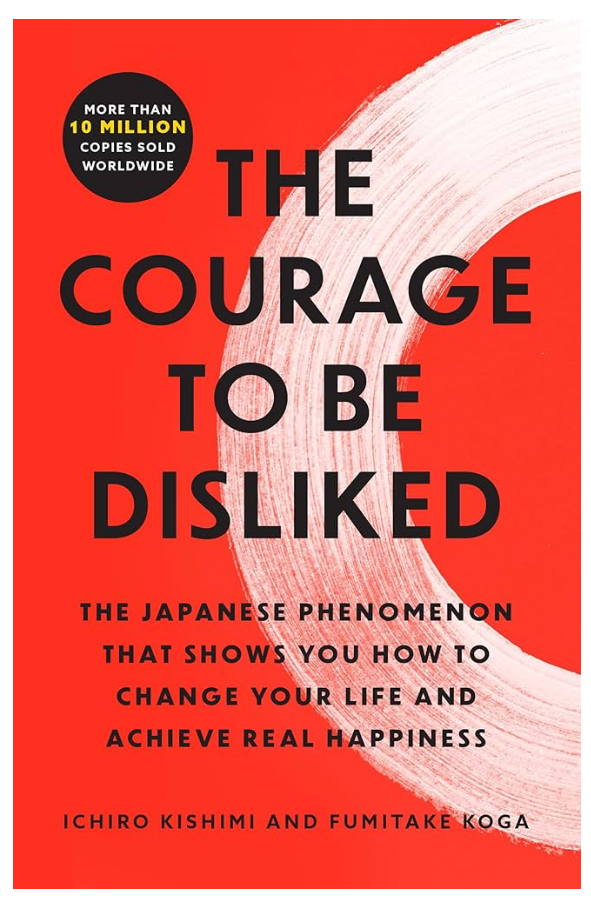
The Courage to be Disliked, is a book written by Ichiro Kishimi and Fumitake Koga, two Japanese authors. Before it was translated into English, the book became a huge hit in Japan. Over 13 million copies have been sold worldwide. It’s based on the theories of renowned psychologist Alfred Adler.
Even though Adler was an Austrian psychologist, the presentation of the ideas in the book are distinctly Japanese. The entire dialogue in the book – the Youth challenging the Philosopher – is structured like a master-student debate. The method is ancient in Japan: a young seeker pushes back, the teacher responds calmly, the truth emerges through discomfort.
The book blends Adler’s psychology with a Japanese philosophical lens; the essence resonates with Japanese cultural ideals:
- Non-attachment to social approval (Zen detachment).
- Living in the present moment (very Zen).
- Harmony in relationships, less focus on hierarchy.
- Finding meaning by contributing to community.
- Courageously choosing your own path (and Japanese concept of ikigai).
A symbol of simplifying one’s inner life, the book became part of a broader Japanese trend toward psychological and spiritual minimalism.
I enjoyed the book, yet it oversimplifies Sigmund Freud's work and idealizes Adler. It’s psychologically inspiring but academically lopsided, in my view. But that’s okay. It’s good storytelling with some powerful core ideas.
Core ideas:
All problems are interpersonal problems
Emotional struggles – anxiety, anger, sadness, inferiority – happen in relation to other people. The key to happiness is learning to separate your life from the judgments, expectations, and emotional baggage of others.
The Separation of Tasks
Your task: the things you can control (your actions, choices, thoughts).
Other people’s task: their reactions, interpretations, feelings.
Most of our suffering comes from obsessing over tasks that don’t belong to us.
We need to ruthlessly manage our thoughts.
Trauma doesn’t determine your destiny
The story we tell ourselves, however, does determine our destiny.
Victimhood stunts a lot of people. We need to let go and move on from our past trauma.
Adler rejected trauma determinism. Your past explains you, but don’t let it bind you.
Letting go is liberating.
Freedom comes from the willingness to be disliked
If your happiness depends on approval, you’re a prisoner.
True freedom is doing what you believe is right.
True courage means accepting that some people will not approve.
It’s not arrogance or rebellion, but the courage to be authentic, to be you.
Happiness comes from community contribution
Adler says the meaning of life is found in contributing to the community, not in chasing status or superiority.
Adler’s term “community feeling” is about belonging, connecting, cooperation, and seeing oneself a part of a larger whole.
Stop chasing validation, pursue contribution, and your life becomes lighter.
Horizontal relationships
Adler emphasizes the importance of treating people as equals – not above, not below.
Vertical relationships (superior/inferior) breed competition, insecurity, resentment.
Horizontal relationships breed warmth, collaboration, and mutual respect.
It’s easier to make new friends with a horizonal mindset.
Live in the “Here and Now”
Adler’s approach is present-focused.
You change by choosing differently today, not by ruminating on the past or waiting for the perfect future.
Tips for Men
These ideas resonate with men because they are about:
- Reclaiming agency – taking charge of your own life.
- Shrugging off expectations from society, family, or past selves.
- Rewriting old narratives.
- Becoming the author of your remaining decades.
- Choosing authenticity instead of a life built around approval.
Conclusion
Men at mid-life often hit the point where they realize they’ve lived a lot of their lives reacting to others. My hope is this essay helps luminate the path to living on your own terms.
Freedom begins when you decide you don’t need to be liked.
The next two weeks I’ll be in Bali, Indonesia with Ang. She has a vacation break for the annual Songkran Thai holiday at the international school where she teaches. After that, one of my best friends from California will visit me. We will spend a couple of weeks traveling around Thailand. Fun times. 😎
All the best,
Peter
This beach is a short walk from my condo in Ao Nang, Krabi, Thailand. Sunset and low tide. I love this place for inner reflection, to connect with the divine universe.

Ang’s school production for the Songkran Festival, the celebration of Thai New Year. I love her passion for, and commitment to, youth and education.

Me, Ang, and friends, Sono and Emily, visiting from South Africa.

Sign up for my newsletter here
Author